A Microplastics Prelude for Engineered Resilience
Mega-Attention on Microplastics
There's a new appetite for microplastics. Earlier this month, the U.S. Environmental Protection Agency (EPA) and Department of Health and Human Services (HHS) announced new actions and funding in the space. HHS's Advanced Research Projects Agency for Health (ARPA-H) launched the Systematic Targeting of MicroPlastics (STOMP) program dedicated to better measurement, toxicity assessment, and downstream interventions on microplastics. The call has a rapid turnaround: a Proposers' Day on April 22nd, solution summaries due May 6th, and full proposals due June 22nd. The government's push to address microplastics has quickly attracted innovators, academic researchers, and newcomers from diverse avenues of biotech, toxicology, engineering and medicine who are transferring their knowledge to this underdeveloped field.
Where do we start? ARPA-H already has the teaming profiles page for those most ready and eager to connect. But the microplastics field is relatively nascent, and the lag in the peer-reviewed literature makes it hard to pin down who's in the field today with funding, and who is producing relevant findings. So I've launched an app to help connect more of the dots (and people) to expedite the hit rate of impactful collaborations.
See Microplastics Research Trendspotter
The Microplastics Research Trendspotter
The Microplastics Research Trendspotter (in beta) overcomes two key challenges by:
- Pinpointing microplastics topic areas that have funding and identifying relevant gaps
- Finding experts who conduct analogous research for other pollutants (e.g., heavy metals, PFAS, pesticides) using approaches that may directly transfer to microplastics
The ultimate goal is to drill down on specific detection systems, experimental designs, or mechanisms of action that are currently underway. To ensure you're looking at recently funded (or most enthusiastic) researchers, this database houses some of the roughly 350 microplastics projects (from NIH RePORTER grants, bioRxiv/medRxiv/PMC papers, and abstracts from the inaugural international microplastics conference in January 2026). STOMP teaming profiles are now added too. There are also ~2,400 NIH grants on other pollutants to query for similar approaches among researchers that have funding.
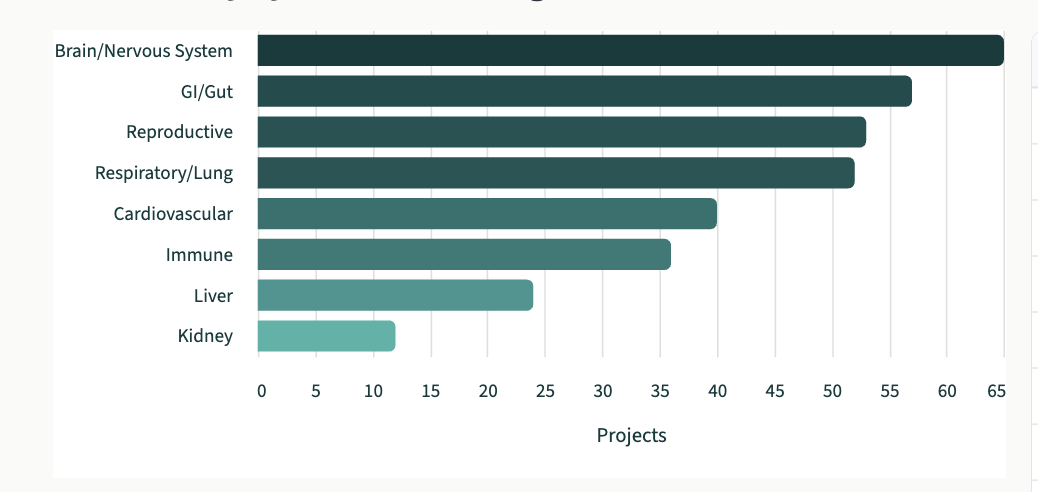
Results from Microplastics Trendspotter showing (left) Sample Types and (right) Analytical Methods across NIH grants, PMC papers, preprints, and ARPA-H STOMP profiles
Key Insights from the App
- ARPA-H highlights the immune system as a route of potential treatment, which warrants greater attention. Currently there is only moderate focus on immune effects relevant to other organ domains (see organ and mechanism tabs in app)
- A surprising number of research groups study how microplastics cross the placental barrier. This could be bolstered further by insights from experts who have funding to examine placental transfer in other pollutant fields (see detection tab)
- Protein dyshomeostasis (or disruption of proteostasis), which is called out by ARPA-H as a mechanism of interest, is already studied by a few experts in the context of pesticides/heavy metal exposures (query for proteostasis in "cross-field insights" tab)
More below on why ARPA-H's rev-up on microplastics is hitting differently.
Motivations for Better Measurement
Despite the spike of interest on these heterogeneous particles, the field is still relatively nascent. Micro- and nanoplastics (MNPs) are infamously tricky to characterize due to their lack of uniformity in size, shape, polymer composition, surface chemistry, and degradation state. There is still no agreed-upon size cutoff distinguishing microplastics from nanoplastics, no validated method for measuring body burden from a blood draw, and no standardized reference particles for labs to benchmark against.
MNPs are at the earliest stage of this arc of research and the unknowns are the same as they were for other heterogenous pollutants (e.g., asbestos, particulate matter, and PFAS) years ago. By my quick count, roughly 40-odd study teams have been funded by the NIH for MNPs since (fiscal year) 2022. There are not even MNP testing standards yet. Hence, ARPA-H released a "sources sought" notice for companies willing to manufacture and sell standardized MP particles for testing. The irony is twofold: producing more plastic to study the plastic already in us, and trying to standardize something that is characteristically non-uniform.
Historical Precedent
MNPs cannot be directly compared to asbestos, particulate matter, or PFAS, but the history of measuring these pollutants can offer a useful precedent for understanding why this ARPA-H call could open a new market. Over the past century, measuring emerging pollutants has repeatedly required building the tools from scratch.
Asbestos fiber counts relied on light microscopy for decades, which could not detect the thinnest fibers most strongly associated with mesothelioma. The advent of transmission electron microscopy in the 1970s-80s enabled detection of much smaller fibers and more precise characterization, fundamentally changing exposure assessment but requiring new instrumentation, standards, and expertise.
Particulate matter (PM) had a parallel problem. Early PM was collected indiscriminately by the high-volume gravimetric sampler adopted in the early 1950s. It took the Harvard Six Cities team to develop their own size-selective samplers from scratch in the late 1970s and refining it over 15 years to produce the measurements that would eventually anchor a federal standard. There was simply insufficient market pressure for more accurate measurement in either case.
In the case of PFAS, demand for improved measurement technologies has been shaped in part by litigation and regulatory developments. Lawsuits against companies such as 3M and DuPont exposed internal documents and heightened awareness of widespread contamination. Over time, evolving scientific evidence and regulatory action pushed EPA guidance levels downward—from provisional health advisories issued in 2009, to a 70 ppt lifetime advisory in 2016, and ultimately to enforceable limits of 4 ppt for PFOA and PFOS in 2024. This co-evolution of litigation, measurement capability, and policy may have stimulated a feedback loop in the 2000s, where improved detection reveals greater contamination, prompting stricter regulation and further demand for sensitive analytical methods.
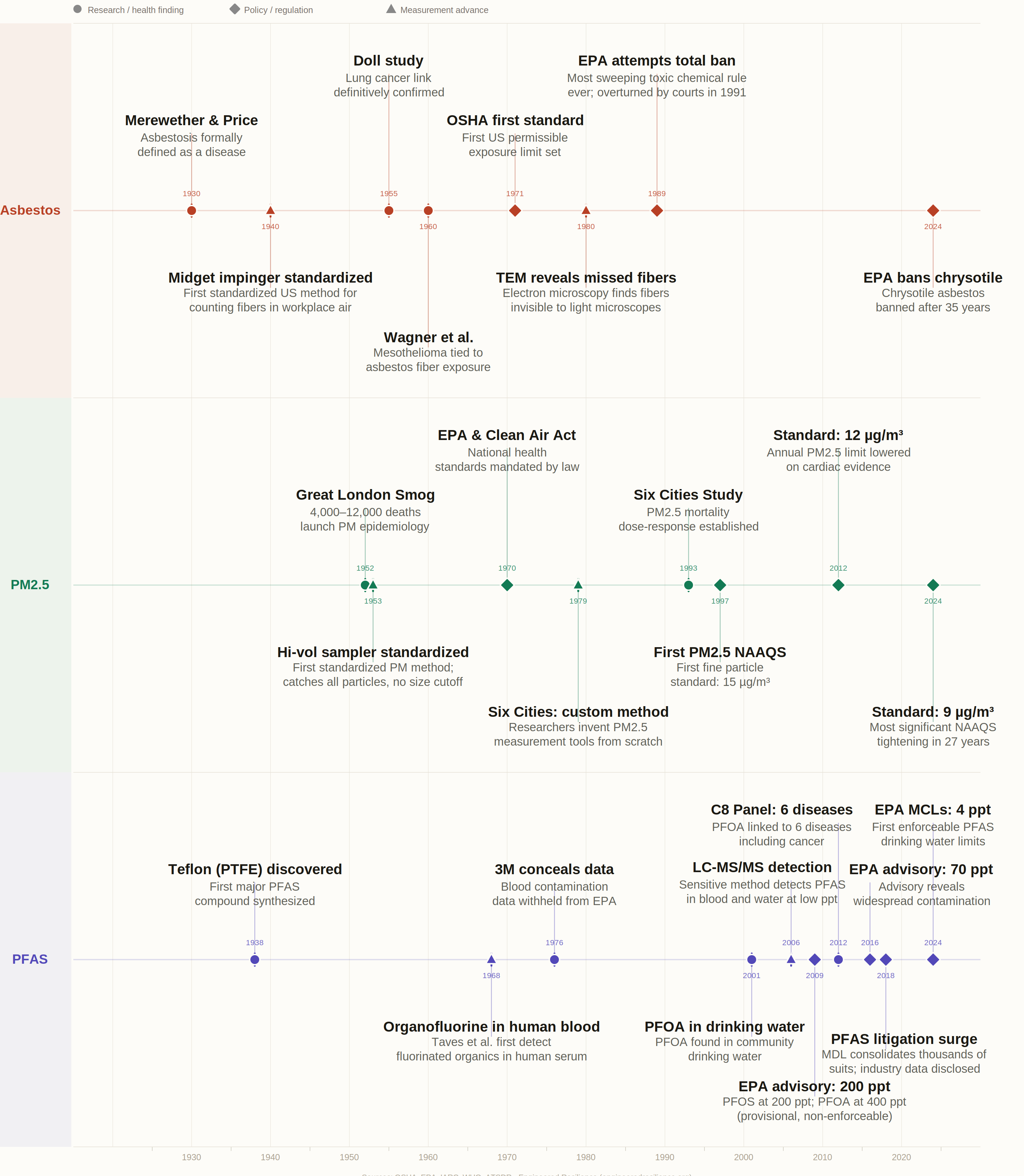
Landmark events, findings, and policy decisions for asbestos, particulate matter (i.e., PM2.5), and "forever chemicals" (i.e., PFAS) that share some similar attributes to microplastics
STOMP-ing on New Funding Ground
ARPA-H's Systematic Targeting of MicroPlastics (STOMP) program, divided into three topic areas, was developed with an end goal that could embed a market-shaping mechanism for microplastics detection technologies.
The first two Topic Areas (TAs) for STOMP follow similar lines to previous government investments in pollutants R&D.
Topic Area 1: Measurement
TA1 funds better measurement of MNPs by a research-grade method, serving as the program's backbone, along with accurate MNP detection in biospecimens (think $50 in less than 15 minutes). ARPA-H also calls for studies correlating biofluid with tissue levels to see if non-invasive methods are sufficient for accurate measurement of body burden. Commercializability of all methods is put front and center.
Topic Area 2: Toxicity & Mechanisms
TA2 funds animal and tissue culture studies to determine routes of exposure (e.g., ingestion versus inhalation) on relevant timescales. A key deliverable for the animal models is traditional pharmacokinetic analyses, to determine the half-life of different polymer types in blood and tissue over a six-month time course. At the cellular level, the questions are which cell types are affected, which biological pathways get disrupted, and whether the body has any innate mechanisms for clearing these particles that could eventually be co-opted for treatment. The mechanistic findings from TA2 directly seed the design of TA3.
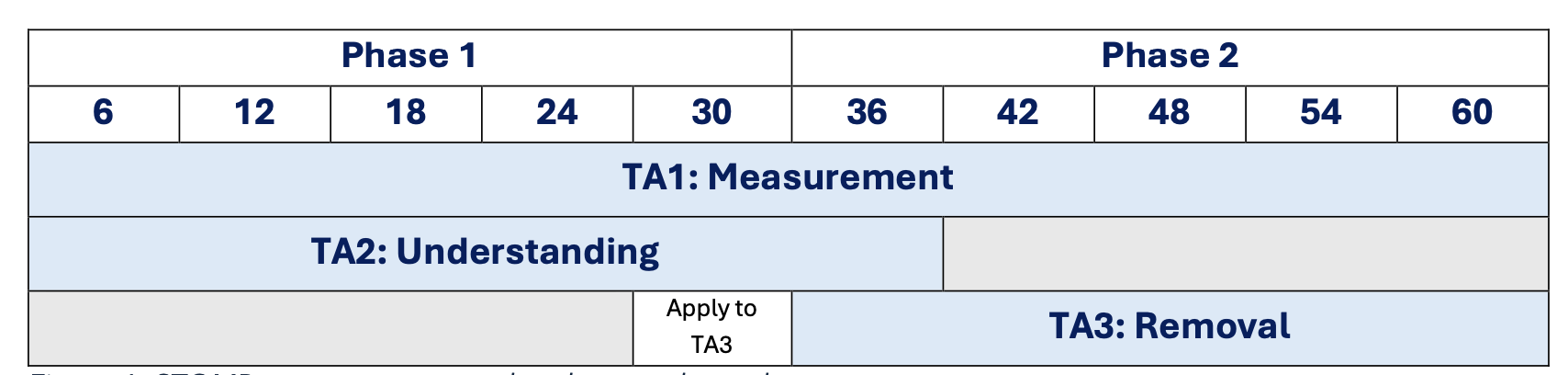
Five-year timeline for Systematic Targeting of Microplastics (STOMP) program in three Topic Areas. (Source: Innovative Solutions Opening, ARPA-H-SOL-26-152)
"Environmental bioremediation research and understanding of MNP degradation and clearance in other species provide possible avenues for translation to human therapeutics."
—Innovative Solutions Opening for STOMP (ARPA-H-SOL-26-152)
Topic Area 3: Clearance & Treatment
Lastly is TA3, which is just a teaser for now. TA3 objectives are to "minimize accumulation, remove and/or degrade MNPs" in an efficient and cost-effective manner. ARPA-H will open that competition around the two-year mark, once TA1 and TA2 have produced enough data to make removal proposals credible.
The bar STOMP sets for TA3 is 80% removal efficacy in a living animal by year five. The framing from ARPA-H is already suggestive of major innovation: waxworm saliva enzymes that degrade polyethylene, engineered gut bacteria that bind and excrete polystyrene, reversal of the cellular trafficking pathways that let particles into tissues in the first place. The only existing removal technique, a dialysis-like blood filtration called apheresis, is explicitly described in the solicitation as currently unproven and insufficient. STOMP treats body burden as a clinical condition and funds the work needed to both detect it and clear it.
A Culture Shift in Environmental Health
Whether or not "performers" (so-called ARPA-H grantees) succeed in achieving clearance or reversal of MNP exposure is secondary. The signal here is what matters. A federal health agency is treating an emerging pollutant as a clinical problem, pairing a companion diagnostic with a therapeutic endpoint.
This framing of measurement plus treatment of a chemical exposure is usually only seen in DoD grants, if at all. Historically, the push for measurements were embedded in academic pursuits aimed at reforming policy (e.g., for asbestos and particulate matter) or was driven reactively by litigation (e.g., PFAS). Pairing a companion diagnostic with treatment for a pollutant exposure is an enticing culture shift in environmental health. If implemented well, this reframing may ultimately bring more biotech resources, talent and innovation with it.
Thank you to Jun Penman for the idea to supplement NIH grants with recent conference abstracts. Grateful to Daniel Goodwin and Sarina Abrishamcar for their insightful feedback on presenting the content. Thank you to many others in the microplastics space, for their help strengthening the app's functionality. Worked with Claude to make visuals, surface historical comparators, and create rapid fire summaries of STOMP.
Have feedback or suggestions? Contact Us**